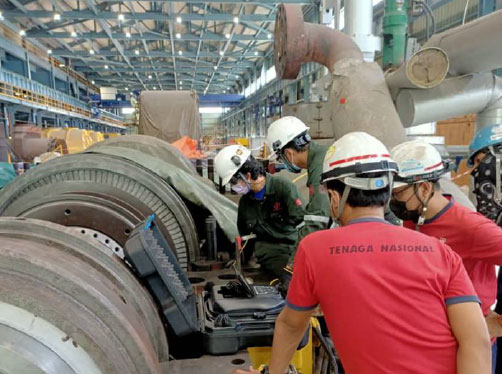
Our Non-Destructive Testing (NDT) service is an analysis techniques used in science and industry to evaluate the properties of a material, component or system without causing damage. You need to monitor and improve the reliability of your processes and equipment.
It is a highly valuable technique that can save both money and time in product evaluation, troubleshooting, corrosion monitoring, and research which avoid manufacturers risk accidents.
Our technical and engineering inspection teams contain highly trained, qualified and certified NDT inspectors to perform that conform nationally and international recognized codes or can be meet to our client’s specific needs.
As a result, we provide to you with complete and valuable data, you enable master key to make decision makes with informed asset management.
Borescope Inspection
A borescope is an optical instrument designed to assist visual inspection of narrow, difficult-to-reach cavities, consisting of a rigid or flexible tube with an eyepiece or display on one end, an objective lens or camera on the other, linked together by an optical or electrical system in between.
Positive Material Identification (PMI)
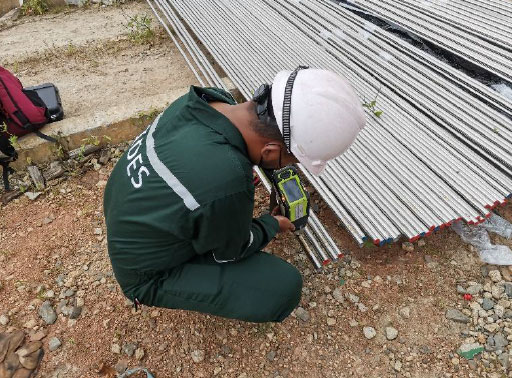
Positive Material Identification (PMI) is the analysis of a material, this can be any material but is generally used for the analysis of metallic alloy to establish composition by reading the quantities by percentage of its constituent elements.
Ultrasonic Flaw Detection (UTFD)
Non-destructive inspection method which utilizes high frequency sound waves to measure physical properties and to identify material flaws. Applications for UT inspection include both surface and subsurface flaw detection in solid materials and welds. Defects, such as laminations, cracks, incomplete fusion, inclusions, and voids can typically be detected.
Ultrasonic Thickness Measurement (UTTM)
Thickness measuring is essential across many industries to monitor corrosion, erosion and damage. Ultrasonic thickness measurement (UTM) is commonly used and the method can be applied to a wide range of structures and components that includes ship hulls, piping, pressure vessels and structural steel.
Plant Inspection – Pressure Vessel
Pressure vessel inspections can refer to an inspection of the vessel’s condition externally, internally, or both. In these inspections, inspectors may: Collect visual data regarding the condition of the vessel, including the condition of insulation, welds, joints, or structural connections.
Plant Inspection – Piping
Piping inspections can refer to an inspection of the pipeline’s condition externally, internally, or both. The inspector will evaluate pipelines and performing tests to ensure the integrity and functionality of pipes
Remotely Operated Vehicle (ROV)
A ROV is visual instrument designed to assist visual inspection for underwater area. By this instrument, initial of underwater condition such in pipeline or tank can be identified. Operator will be maneuvering the instrument via remote control which connected to the instrument.
Unmanned Aerial System (UAS) / DRONE
A UAS is aerial visual using drone assist visual inspection for high rise location such as tower and other high equipment which cannot be reached. Operator will control drone via remote control which connected wirelessly.